
Archives for May 2026
Rural Capacity Program Opens with Eight More Slots
CEDA is encouraging Minnesota’s smallest cities, those with a population of 3,000 or less, to take advantage of a unique opportunity designed to help rural cities build local capacity, support economic growth, and invest in economic development tools.
Through the Rural Capacity Program, cities with populations of 3,000 or fewer can receive:
- up to 135 hours of technical assistance from Community and Economic Development Associates (CEDA) as well as;
- up to $13,500 in grant funding to help implement locally driven economic development initiatives.
The program is supported through a special appropriation from the State of Minnesota and was created specifically to assist rural communities that may have limited staff capacity, smaller budgets, or little formal economic development infrastructure, but still have strong ideas and goals for their future.
The program allows communities to work directly with one of CEDA’s Rural Capacity Program Specialists to develop a customized initiative tailored to local needs. Eligible projects may include revolving loan funds, commercial exterior improvement programs, childcare incentive programs, or business retention and expansion initiatives.
Several communities participating in the current round are already seeing momentum from the program. One participating city used their technical assistance hours to rewrite, streamline and make existing programming more accessible to businesses in their community, one is using funds and technical assistance to ignite interest around available industrial land, one is using funds to develop an in depth Business Retention and Expansion program, each participating city is working with a CEDA RCP Specialist to develop unique programming that benefits their businesses and community! It looks different for everyone!
At CEDA we believe, there is no one-size-fits-all approach to rural economic development. Each community has unique opportunities and challenges, and this program is intended to meet communities where they are.
In addition to technical assistance, participating cities benefit from CEDA’s network of professional staff and partnerships with local organizations, businesses, and state agencies to help maximize project impact and long-term sustainability.
Communities do not need to have an Economic Development Authority (EDA) to apply, and every effort will be made to distribute awards equitably throughout Greater Minnesota.
Rural communities interested in applying are encouraged to contact Amy Schaefer, Rural Capacity Program Manager @ amy.schaefer@cedausa.com for additional information
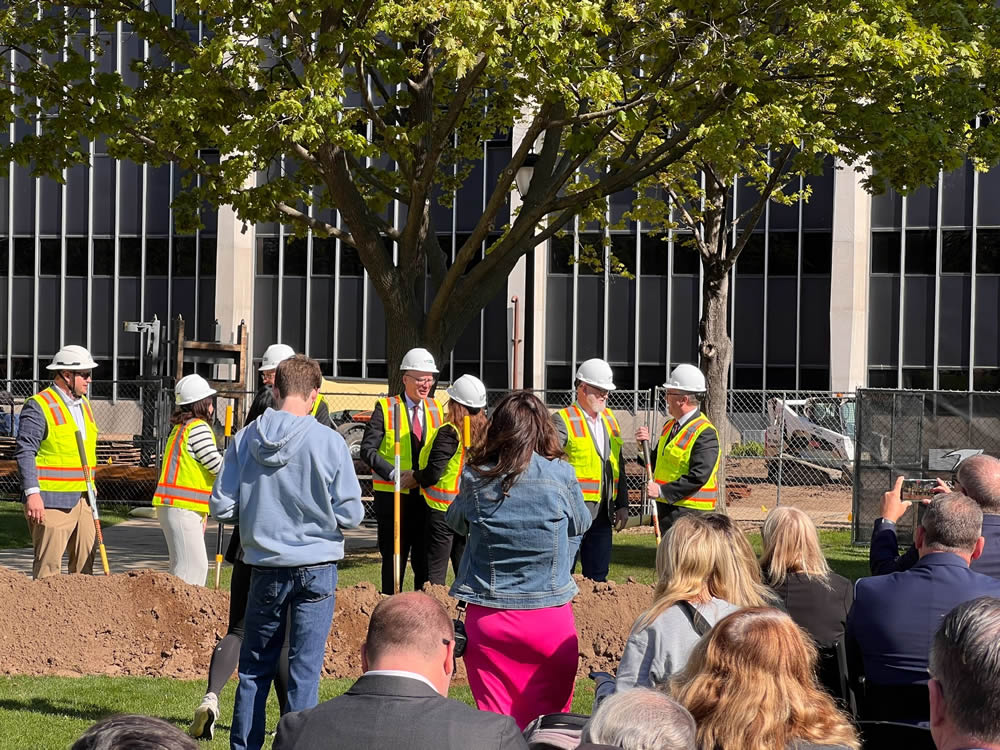
The second phase of the University of Wisconsin-La Crosse Prairie Springs Science Center broke ground on Friday, May 8.
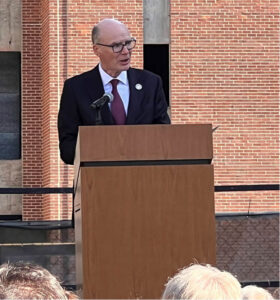 The ceremonial groundbreaking marked the unofficial start of the $194 million project, which will replace Cowley Hall with 30 state-of-the-art labs, classrooms and specialized learning spaces, with completion expected in late 2028.
Together, the two phases will form a comprehensive hub supporting education, research and innovation across a variety of STEM fields.
Chancellor James Beeby expressed his appreciation for the broad network of supporters who through the years advocated for the completion of Prairie Springs: students, staff and faculty; alumni and friends; business and community partners; local, state and federal legislators; and others.
Chris Hardie, 7 Rivers Alliance CEO and CEDA staff member, was among those who testified at various Wisconsin legislative hearings the past few years in support of the project.
Hardie is a 1986 graduate of UW-La Crosse. Beeby also is a board member of 7 Rivers Alliance.
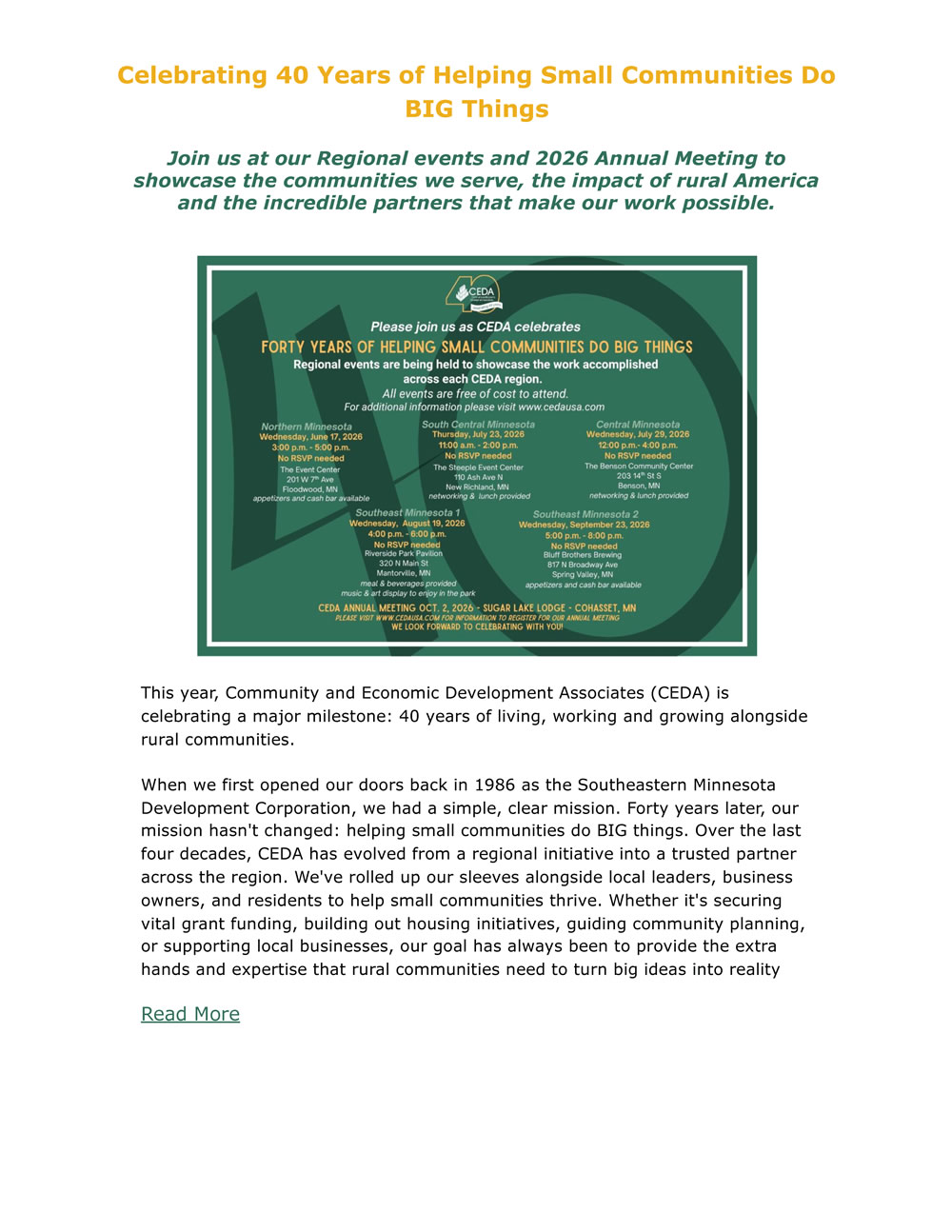
HCBT Holds Their Annual Banquet Celebrating Rural Economic Development in Howard County
For the last thirty years, Howard County Business and Tourism has partnered with the Times Plain Dealer newspaper to present several awards to outstanding individuals from Howard County, IA. In addition to these special recognitions, the annual banquet hosts at least two guest speakers, one of which is an elected official from the state of Iowa, and the other a well-known individual(s) and leader in Howard County. Both of these awardees hold accolades in their respective fields of expertise and experience, and are selected for their dedication to community, small business, and rural development and sustainability.
This year, the banquet hosted Debi Durham, Director of both Iowa’s Economic Development Authority and the Iowa Finance Authority, and Howard County Sheriff Rick Busch. Rick brings decades of state and federal law enforcement experience to his position as Sheriff. Both presented insightful, informative, and inspiring presentations on their careers, importance of rural economic development, and what community involvement and investment looks like to them. Past speakers include former lieutenant governor (now governor) Kim Reynolds, Senator Joni Ernst, a former hospital CEO, and a school superintendent.
Additionally, Howard County Business and Tourism Director and CEDA VP of Iowa Jason Passmore introduced this year’s speakers and offered many thanks to those in attendance and who helped make the banquet a success. Community and Economic Development Associates’ CEO Ron Zeigler was also in attendance and spoke about rural economic development and the ongoing achievements, challenges, and efforts in NE Iowa and beyond. He noted that this year is CEDA’s 40th year in operation, a huge achievement for a small non-profit that started in SE Minnesota with the main objective of helping rural communities grow and thrive.
The “Hall of Fame” Awards presented each year are Citizen, Organization, and Educator of the Year, the latter being the most recent added to the Hall of Fame. These outstanding individuals are nominated by their peers and community members by way of letters submitted to the Times Plain Dealer. They are then selected by a committee, notified by a TPD staff member, and an article written about them and published in the paper prior to the awards ceremony. Even though for many years nominees were awarded (and surprised!) at the ceremony itself, the process was altered to allow for winners to know in advance so as to invite family and friends to be a part of the banquet and ceremony.
This year’s banquet accommodated and catered to over 100 attendees, speakers, and award winners. It was a night of community recognition and appreciation of hard work, dedication, service, as well as showcasing a positive impact for people who live and work in all the surrounding communities. As Howard County continues to shine in areas of community and economic development, its residents continue to go above and beyond in many ways that celebrate togetherness and comradery, all while supporting businesses, organizations, and the act of volunteerism.
Envision Plainview SPARK Session introduces Business Toolkit and new eNavigator
By Lindsay Hammer Bartley
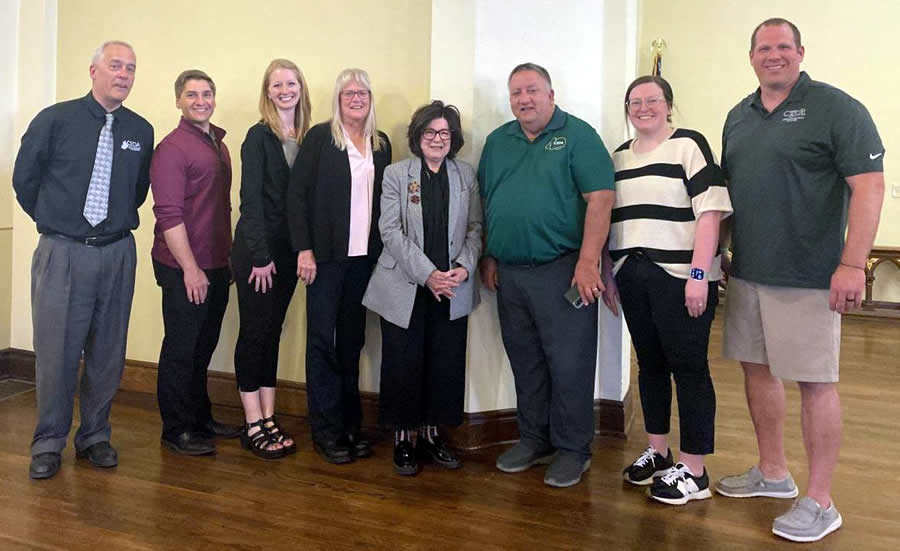
On May 18th, the Envision Plainview team hosted a SPARK session at the Plainview Public Library to launch their collaboration with Kindling (Shantelle Speedling) in the Entrepreneur Navigator role (E-Navigator), and to reveal a Business Toolkit. Allison Whalen, Community and Business Development Specialist supporting the Envision Plainview group demonstrated the web-based toolkit which can be accessed from the City’s website under the EDA page: www.plainviewmn.com/o/eda/page/plainview-business-toolkit2.
Shantelle Speedling, Kindling consultant, shared her scope of services and was available to answer questions of those in attendance. In her E-Navigator advisory role , she is available to help aspiring and early-stage entrepreneurs clarify business ideas, assess readiness, and connect with appropriate resources. The role is intended to complement existing economic development programs by serving as an accessible entry point for entrepreneurs prior to engagement with formal programs or services. Shantelle will collaborate with Trisha Hess, Plainview Economic Development Authority (EDA) Director when entrepreneurs are ready to advance their business plans. Meg Curtis, Programming and Outreach Librarian, shared resources, and services the library can offer entrepreneurs and business owners, including printing services and a new reservable private workspace.
The business toolkit and Kindling partnership is the culmination of nearly 3 years of dedicated work from the Envision Plainview team. The team is composed of select members of the EDA , City Council, and community members who conducted a thorough assessment of the local entrepreneurial climate. This included interviews with business owners to identify resources that could support the needs of entrepreneurs in various stages of business planning. Based on feedback and themes gathered from those conversations, Envision Plainview created the Business Toolkit for both existing business owners and individuals who are considering starting an entrepreneurial venture.
The work conducted by Envision Plainview, the toolkit creation, and partnership with Kindling is funded through a grant from Southern Minnesota Initiative Foundation (SMIF). The grant funds have been used to provide outreach, education, and advisory support services that strengthen the entrepreneurial and small business environment in Plainview.
